


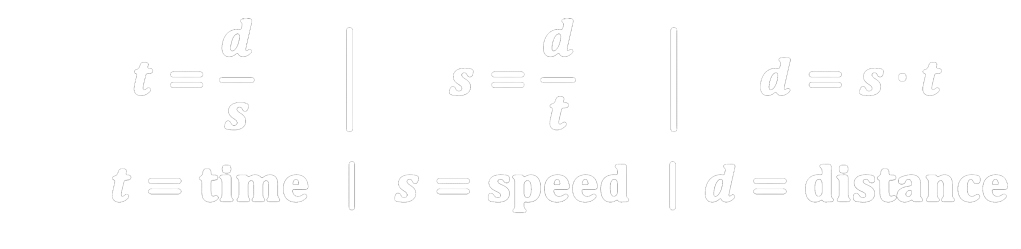
Time is the primary focus of this equation. We don’t know how to get it back, so we naturally don’t want to waste it. The constant nagging issue with interstellar travel is the vast distances that would need to be traveled at comparatively low speeds. This is only a problem because it would to take so much time. The milky way galaxy is 100,000 light years across or 1,000,000,000,000,000,000 (18 zeros) km or 1 quintillion km! So, travelling at an astounding average of 1 million KPH, it would still take over 100 million years (1 trillion hours). That simply is just too long of a trip for anyone. Light travels at just over 1 billion KPH. That is still not fast enough and would still take 100,000 years (100,000 light years at the speed of light). Time gets slippery as soon as Earth is left behind. Time dilation is a real thing that is observed and becomes more severe as celestial bodies of different masses come into play (Interstellar). Time travel (forward and backward) is theorized, and attempts at time travel are often messily portrayed in media. The distortion of time quickly reveals itself as the most difficult part of the equation to understand or attempt.
Speed is the typical starting point. If while driving a car you want to arrive at your destination sooner you would simply go faster. Many depictions of interstellar travel simply boost the speed of travel to almost certainly impossible levels and call it good. Even worse, these speeds (that are far faster than light) are accelerated to in mere seconds. There is often a technological (magic) device that has some fancy name (Inertial Dampener) that helps to explain how the crew is able to resist exploding under their own dramatically increased weight resulting from such an acceleration. The bigger issue though is that the universe does actually have a speed limit. That speed limit is the speed of light (1 billion KPH) . And even then, it is fuel inefficient to reach and extremely dangerous for anything maintain the speed of light if it is even achievable. Another issue is the acceleration component. Accelerating to the speed of light would take a long time. Some have theorized that just getting to 50% the speed of light at a consistent and bearable 1G acceleration (felt earth-gravity) would take in the ballpark of 6 months. Accelerating to speeds over 50% the speed of light would be even less efficient timewise. Slowing down would take just as long. These are all probably idealistic estimates anyway.
Distance is typically not the first thing we attempt to change when trying to reduce the time it takes to get to work. Typically, it is not in our control to change it much, but we recognize when it does, for example distance may increases due to some unexpected road work detour. Simply reducing the distance from A to B, would however drastically reduce the speed required to travel to B in a timely manner. This solution would also not break the cosmic speed limit (technically) nor would time dilation be an issue. Changing the distance traveled may seem like a shortcut (it is), but it is one of the most considered FTL (faster than light) theories today. The idea is not new to sci-fi and is better known as warp technology (warp-drive, warp-core… etc.). The idea is to somehow compress the space in front of the vessel while expanding the space behind. This would in essence reduce the distance that would need to be traveled. One issue in the need for massive amounts of negative energy, which would require a ridiculous amount of mass (entire universe) to produce (Alcubierre – 1994). More recently it has been shown that that mass could theoretically be decreased to the mass of our sun with similar results. It may even be possible to remove the need for negative energy as well as again reducing the required mass to that of Jupiter (still a big ask).
Interstellar travel is not solved, but I hope this very simple (very) dive into the factors that go into the how (time, speed, and distance) showed that distance may be the best way forward. The Tau Zero Foundation is currently working on interstellar travel and warp technology is one of their considerations.
 Fabric Gaming